How far ahead should brands plan merch (and why last-minute costs more)
When it comes to branded merchandise, “how long will it take?” isn’t always as straightforward as it sounds.
A product might be in stock and ready to go, but there can still be artwork to approve, branding to complete, quantities to confirm and delivery to arrange before it reaches you.
And when you’re working to a tight deadline, those options can start to disappear.
At The Sourcer, we work with everything from quick-turnaround promotional products to bespoke merchandise projects, so we know that the amount of time you have can have a real impact on both what you can choose and what it costs.
So, how far ahead should you plan?
There isn’t one magic lead time for every merch order. It depends on what you’re buying, how many you need, how it needs to be branded and where it’s going.
As a general guide:
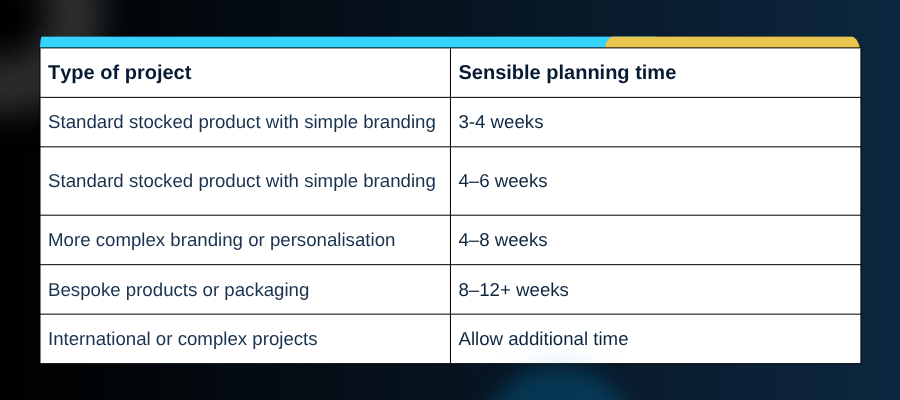
These are planning guidelines rather than guaranteed lead times. Stock levels, supplier capacity, production schedules and the time of year can all make a difference.
And if you’ve got less time than this, don’t automatically assume it’s too late. There are plenty of products and production routes designed for shorter lead times. We just need to know the deadline so we can concentrate on options that are realistically achievable.
Why does last-minute merch cost more?
This is where things can get interesting.
Last-minute doesn’t automatically mean expensive. Sometimes we can source exactly what you need quickly and at the expected price.
The problem is that the shorter the timeframe, the fewer options you may have.
And fewer options can mean higher costs, fewer customisation options, and less time for sampling.
Express production
Some products can be produced within a standard manufacturing timeframe, but if you need them sooner, an express production service may be available. That can come at a much higher cost.
Faster delivery
If standard delivery won’t meet your deadline, you may need a faster courier service or an alternative delivery route.
The product itself hasn’t become more expensive. You’re paying for the additional speed required to get it to you in time.
Fewer opportunities to compare
When there’s plenty of time, we can look at different products, suppliers and production methods.
With a deadline looming, there may not be time to explore every alternative.
You might have to choose the product that’s available and achievable rather than the product that offers the best overall combination of price, specification and branding.
Stock availability
This can be particularly important for larger orders.
If you need 500 units but a supplier only has 300 available, we may need to look at another supplier or product.
Less room for problems
This is the cost that doesn’t always appear on a quote.
If artwork needs changing, a sample isn’t quite right, stock arrives later than expected or a delivery issue occurs, having a few extra days gives you somewhere to go.
When you’re ordering at the last minute, there may be no room to absorb those delays, which can mean paying for a faster alternative.
It’s not just about delivery time
One of the easiest mistakes to make is looking at a product’s advertised lead time and assuming that’s the amount of time you need.
If a product has a five-working-day production time, for example, you still need to consider everything that happens around it.
A typical order might involve:
Brief → product selection → stock check → artwork → approval → production → quality checking → delivery
Not every order will need every stage, but that’s why we recommend working backwards from the date the merchandise needs to be ready to use, rather than simply the date you need it delivered.
If you’re supplying merchandise for an event, for example, it may need to arrive with your team several days beforehand so it can be checked, packed or transported to the venue.
Sharing the deadline beforehand will always help us make sure your items arrive on time.
The product itself makes a big difference
Not all merchandise needs the same amount of planning.
A stocked notebook with a simple one-colour logo is a very different proposition from a bespoke jacket with multiple branding positions and individual names.
Things that can increase the time required include:
Bespoke products
Anything being manufactured specifically for you will usually require more planning than an existing catalogue product.
Personalisation
Individual names, numbers or other variable data add another stage to production and checking.
Multiple branding positions
Adding branding in several locations can increase production time and complexity.
Bespoke packaging
Custom boxes, sleeves, inserts and other packaging can have their own artwork and production timelines.
Large quantities
Larger orders can affect stock availability and production capacity.
Samples
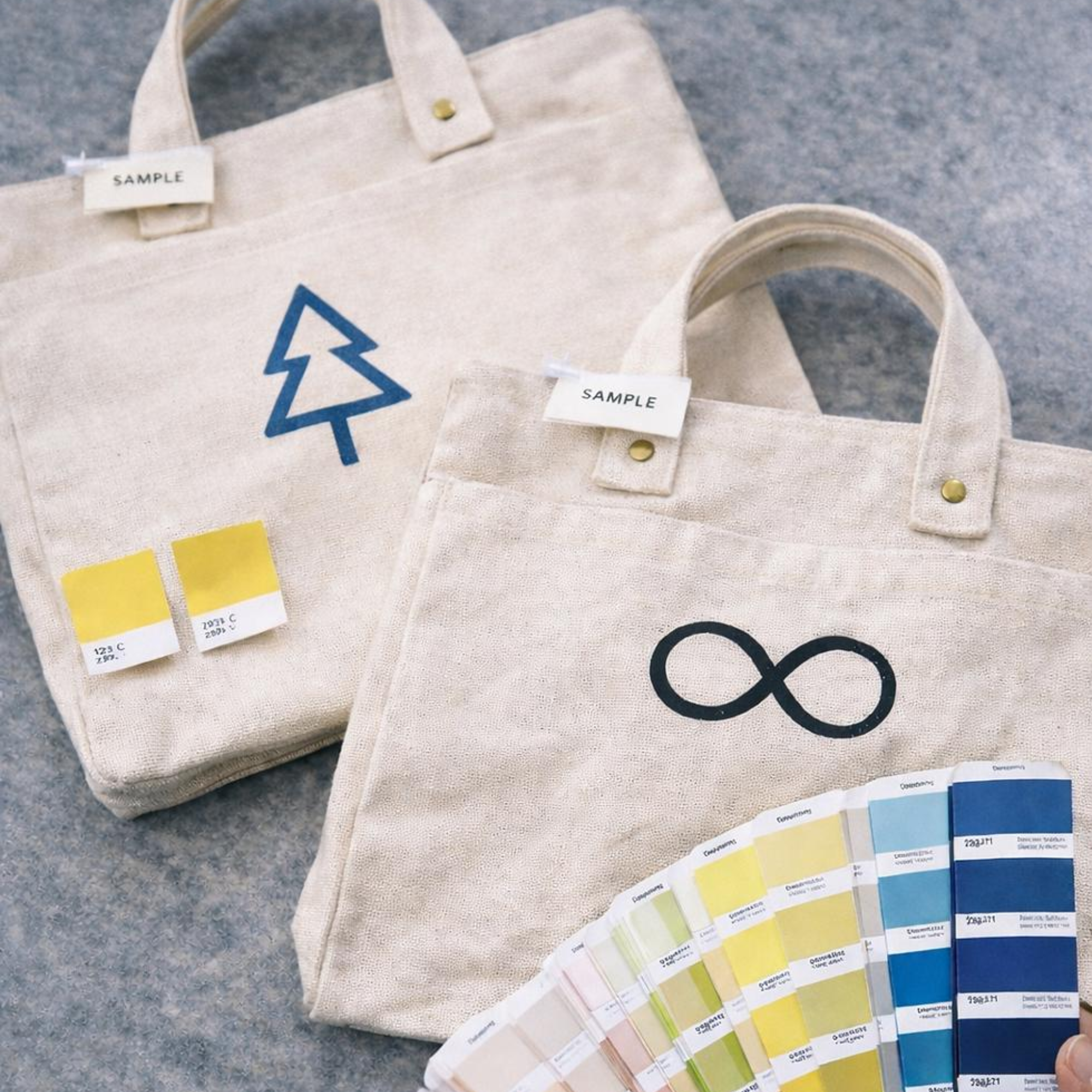
For some projects, particularly bespoke or higher-value orders, you may want to approve a physical sample before production.
None of these are reasons not to do something. They just need to be factored into the timeline.
What about sustainability?
This is another area where having more time can be useful.
If sustainability is important to the project, we can look beyond whatever happens to be available immediately and consider factors such as recycled or responsibly sourced materials, product durability, packaging and how likely the item is to be used.
The most sustainable option isn’t necessarily the one with the most impressive claim on the packaging. It’s about considering the product as a whole and whether it is actually useful to the person receiving it.
Having time to explore those options can make a difference.

What if you’ve left it until the last minute?
Don’t panic.
Urgent orders are something we deal with regularly, and there are plenty of ways to make a shorter timeframe work.
The most useful thing you can do is tell us the FINAL deadline at the start.
Not just “we need these for an event on Friday”, but when the products actually need to be in your hands, how many you need and what branding is required.
That lets us focus on products and production routes that have a realistic chance of meeting the deadline.
Sometimes that will mean finding an alternative product. Sometimes it might mean changing the branding method or looking at an express option.
And sometimes we’ll tell you that something isn’t realistic within the timeframe and suggest an alternative.
We’d much rather do that at the beginning than have you find out when it’s too late to change course.

Our advice: work backwards
If you have a campaign, event or launch coming up, start with the date the merchandise needs to be ready and work backwards.
Think about:
When does it need to arrive?
Allow enough time for checking, packing or onward delivery if necessary.
What needs to happen before production?
Artwork, approvals, samples and personalisation can all add time.
Is the product readily available?
Stocked products are generally easier to turn around than bespoke items.
How flexible are you?
If your exact product, colour or specification isn’t available, would you consider alternatives?
What happens if something changes?
Where possible, build in a little contingency rather than planning everything to arrive on the day you need it.
The bottom line
Planning your merchandise earlier doesn’t guarantee a cheaper order. And leaving it until the last minute doesn’t automatically mean you’ll pay more.
What it does do is change the number of options available to you.
With more time, there is more opportunity to compare products, check availability, consider different production methods and choose the most suitable delivery option.
With less time, you may need to pay for speed or compromise on some of those choices.
At The Sourcer, we’re happy to work with both.
If you’ve got plenty of time, we’ll help you explore the options. If you’ve got a deadline next week, we’ll work out what’s realistic.
But if you’ve left it late, give us a call anyway (we are calm under pressure!)